

Our Insights
May 14, 2025

As organisations rush to implement AI-first approaches, it is becoming apparent that the biggest risk companies may face in their AI implementation journey might be resistance to the technology itself. Despite the promises of increased productivity and efficiency, the gap between expectation and reality has started to widen, creating new challenges for businesses and employees alike.
AI promises to transform our work lives, but this may not be a simple process. In fact, it may be quite the opposite. According to EY’s latest pulse report, half (50%) of senior leaders polled reported that overall enthusiasm around AI integration and adoption had declined at their organisation in the last six months, even as ROI had increased, with two 2 out of 3 (65%) of managers admit they’ve been struggling to keep staff motivated about using the technology. This paradoxical finding highlights a disconnect between executive expectations and the frontline implementation of AI.
This gap may be further explained by another study, this time by gig-economy and freelance platform Upwork, which found that despite 96% of C-suite leaders expressing high expectations that AI will enhance productivity, 77% of employees actually using AI are starting to recognise that it is adding to their workload. But what may be more problematic is that nearly half (47%) of employees using AI have no idea how to achieve the productivity gains their managers expect, with almost as many (40%), feeling their company is asking too much of them when it comes to AI.

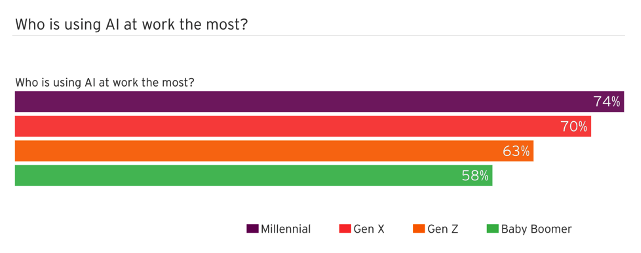
When we look at it through a generational lens it becomes even more interesting. The biggest proponents of AI are millennials, ahead of their career next-in-liners Gen X (70%), followed by Gen Z (63%) and finally Boomers (58%) coming in as the ‘not-so-early-adopters’. Some might suggest millennials and Gen X are more likely to take on leadership roles in the next while and therefore may see the value in increased productivity. But they are struggling to convince their more junior colleagues to implement AI effectively. Conversely, Gen Z may already have noticed the writing on the wall – that more AI means more work.
Nevertheless, Boomers don’t seem to be using AI as much as anyone else. While not surprising, this may end up contributing more negatively to the culture problem in years to come, especially as productivity gains become ever more enticing. But unless organisations address any friction that may arise, there is potential risk that both workloads and morale could start to place strain on company culture.
Source: EY
The fundamental disconnect between leadership vision and employee experience creates a cascade of challenges. The pressure to adopt AI tools is taking a toll on workers. EY’s research indicates that more than half of senior leaders (53%) report their employees are feeling overwhelmed or exhausted by the constant influx of AI information and developments.
This burnout is compounded by another study, this time into AI anxiety, which identifies the widespread uncertainty about responsible AI use. The study found that 65% of employees are anxious about whether they’re using AI responsibly, with:
This dynamic is illustrated by a cautionary tale – an HR software company boldly announced they were “making history” by fully integrating AI models into organisational charts. As reported by Futurism.com, the company claimed, “AI workers will have managers and will be held accountable to specific goals and standards so employers can measure and assess their performance like with any other employee.” This concept of extending rights to “digital employees” that don’t exist didn’t sit well with its human employees, leading to major backlash and eventually forcing the company to reconsider their entire approach.
We often talk about AI as a tool for disruption — but thoughtful integration is far less glamorous and far more human. It’s not about replacing roles; it’s about rethinking routines.
So, the real question leaders may want to ask is:
True integration means reimagining the way we do things, not just plugging in tech when we can’t work it out. It means rebalancing workloads, not increasing them. And it means making room for uncertainty –– for learning, experimentation, and even a little mess, rather than chasing frictionless automation at all costs.
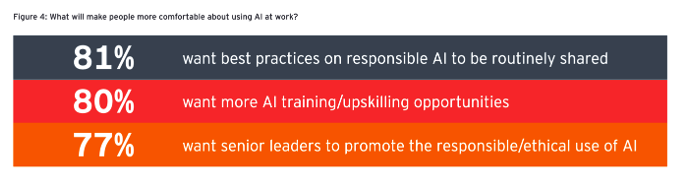
Employees will need a lot of guidance to unpack the opportunities that AI brings. They will need encouragement and support to build confidence in using the tools. In fact, they’re crying out for it. And leaders will need to carefully unpack what responsible AI means for their organisation, instead of leaving employees to figure this out for themselves.
Source: EY
But if we ignore this for too long, the greatest challenge may not be technical, but cultural. It is up to leaders to create environments where AI serves as a trusted partner rather than a source of anxiety or unrealistic expectations and that will mean leaning into the challenge.
Disclaimer: This article was researched with assistance from AI, specifically Claude 3.7 Sonnet and Perplexity.ai. The original content was drafted based on research compiled from multiple sources including EY, Anthropic, Upwork, MIT Technology Review, and Futurism.com. All statements attributed to these organisations are based on their published research or content. The final article was reviewed and edited by human professionals to ensure accuracy and relevance. The use of AI in creating this content exemplifies the collaborative approach to content development described within the article itself and underscores our transparent approach to using AI, at Aprio Group.
For more information about Aprio’s digital service offering, contact Thomas McLachlan on thomas@aprio.co.za
Our Insights: View More Articles, Podcasts and video


