Our Insights
August 28, 2026
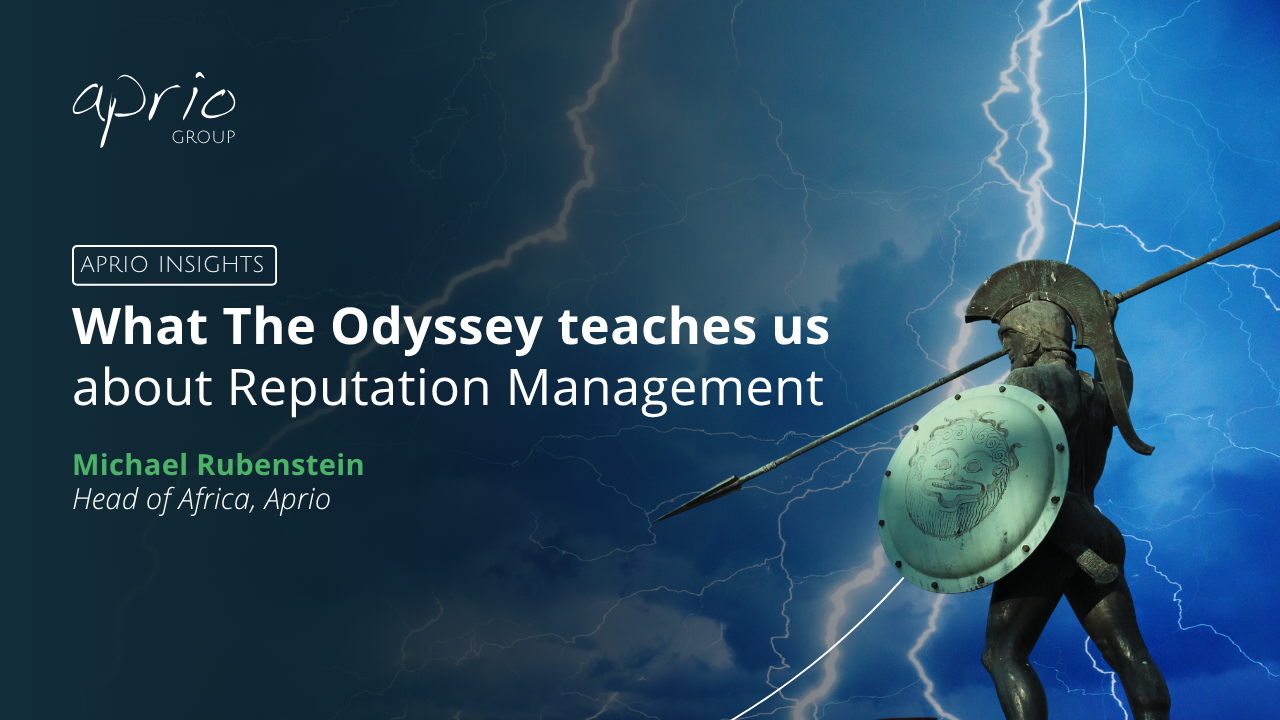
– Michael Rubenstein, Head of Africa, Aprio
Truth be told, I haven’t read Homer’s The Odyssey, but that did not stop me from enjoying the Christopher Nolan blockbuster version, at the super sensory-intensive IMAX, theatre. It was Epic!
Beneath the mythology, monsters and maritime adventures lies something surprisingly relevant to today’s corporate world: a masterclass in navigating uncertainty, preserving reputation and staying focused on a long-term objective despite constant disruption, including leadership turmoil.
As a strategic communications professional, I am often asked how organisations can build stronger reputations, launch successful brands, and maintain stakeholder trust in an increasingly volatile environment. My answer is usually the same: think less about campaigns and more about journeys.
Every organisation has an Ithaca (the kingdom and home of the hero Odysseus).
For some, it’s becoming the market leader or thought leader in a sector. For others, it’s successfully navigating a crisis, earning investor confidence, driving customer loyalty or strengthening stakeholder trust. Whatever the goal, the journey begins with a clear destination. Without it, communications activity quickly becomes noise. Press releases get published, content gets written, media engagements take place, but none of it is tied to a meaningful outcome.
Too often organisations become consumed with tactics. They focus on corporate communications without first defining the reputational outcome they are trying to achieve. Activity without purpose creates movement but not progress.
The most successful communications strategies identify where the organisation wants to be and then map the stakeholder journey required to get there. Like Odysseus, who never lost sight of Ithaca despite years of setbacks, organisations must remain focused on their long-term reputation goals even when faced with short-term headwinds.
And headwinds will inevitably come.
Odysseus faced Cyclopes, shipwrecks, storms, sea monsters and hostile gods. Modern organisations face a different but equally complex set of threats. Modern organisations face a different but equally complex set of threats. Cyber and data breaches. Fatal safety incidents. Product recalls. Corporate governance failures. Litigation. Regulatory interventions, and more – all of which can strike with little to no warning.
In South Africa, where public trust is increasingly influenced by transparency, accountability and corporate behaviour, these challenges can escalate rapidly. A single incident can shatter customer and client loyalty, attract Regulator scrutiny, impact employee morale, unsettle investors and dominate media conversations for weeks.
This is why crisis communication or issue management should never be viewed as a standalone discipline. In fact, a company’s reputation is rarely defined by how it behaves when everything is going well. It is defined by how it responds when things go wrong.
One of the most memorable scenes in the cinema version of The Odyssey is Odysseus’ encounter with the Sirens. Their enchanting songs lured sailors towards destruction, causing them to abandon their course and crash upon the rocks. Knowing the danger ahead, Odysseus prepared in advance. He instructed his crew to block their ears with wax and had himself tied securely to the mast so that, even if he was tempted, he could not change direction.
This may be one of the most powerful metaphors for modern communications leadership.
Every organisation faces its own Sirens. These are the distractions that tempt leaders away from strategic priorities. Some Sirens are external. Others are self-inflicted.
Many reputational crises become significantly worse because organisations abandon strategy in favour of panic. They react emotionally rather than strategically. They issue poorly considered statements. They contradict previous positions. They overcommunicate, under-communicate or communicate inconsistently. In doing so, they create confusion precisely when stakeholders are looking for certainty.
The lesson from Odysseus is simple: preparation creates resilience.
Every organisation needs its own mast “north star” or set of values, to hold onto when turbulence arises. That mast also consists of a clearly defined reputation strategy, agreed messaging frameworks, stakeholder engagement plans, escalation procedures and crisis communication protocols. When pressure mounts, these structures provide stability. Critically, they must be in place before a crisis occurs.
One of the biggest misconceptions in corporate communications is that crisis preparedness is something organisations can address when needed. The reality is that by the time the crisis arrives, it is already too late to start preparing.
Just as no sensible business waits for a fire before installing smoke detectors, no organisation should wait for a reputational crisis before building a crisis communications playbook. In fact, the organisations that navigate crises most effectively are rarely the ones that avoid problems altogether. They are the ones that anticipated potential risks, conducted scenario planning, trained spokespeople, developed response frameworks and established stakeholder relationships long before they were tested.
Stakeholder management, which is ultimately about advocacy and building fans of your business, is critical for long-term sustainable reputational success.
Like Athena guiding Odysseus, organisations also need allies. Employees, customers, industry experts, media, partners, community leaders and trusted advocates all contribute to reputation. Their voices often carry greater credibility than corporate messaging alone.
Ultimately, The Odyssey reminds us that reputation is not a destination that can be reached and forgotten. It is an ongoing journey requiring constant attention, adaptation and discipline.
That is why reputation management cannot be treated as a campaign, an annual initiative or a reactive function. It is a 24/7/365 responsibility. Every leadership decision, stakeholder interaction, customer experience, media engagement and public statement contributes to the perceptions that define an organisation.
The companies that arrive safely at their Ithaca are not necessarily those that encounter the fewest storms. They are the ones that prepare for them. They understand and invest in their stakeholder relationships, remain anchored to purpose, and develop the resilience to navigate uncertainty when it inevitably arises.
Ultimately, the enduring relevance of The Odyssey lies in its reminder that successful reputation management is not defined by the absence of challenges. It is defined by how those challenges are navigated. And, it is protected by everything an organisation does before the crisis ever arrives.
Footnote: The reputation lesson behind the Odyssey
There is a debate surrounding Christopher Nolan’s The Odyssey, that offers a fascinating real-world example of reputation management in action. While the film has generated enormous excitement, criticism emerged from some Greek commentators and media outlets over the absence of Greek actors in a story that sits at the heart of Greek cultural heritage. The controversy was not primarily about the film’s artistic merit, but rather about representation, authenticity and who has the right to tell certain stories.
For communicators, the lesson is significant: reputation is often shaped less by what organisations intend and more by how stakeholders interpret their decisions. Nolan’s production team may have viewed the casting through the lens of global appeal and international representation, but a key stakeholder group viewed it through the lens of cultural ownership and inclusion. This demonstrates why effective reputation management requires organisations to look beyond their own assumptions and proactively identify how different audiences may perceive their actions. Just as Odysseus prepared for dangers before encountering them, organisations must anticipate potential stakeholder concerns before they become public controversies. In today’s environment, reputation is built not only through what you communicate, but through your ability to anticipate how your decisions will be received, interpreted and debated
Our Insights: View More Articles, Podcasts and video